Cool weather is the best time to fertilize trees and shrubs. But is it necessary? If needed, what nutrients are required?
There are three potentially conflicting views on Tree Fertilization and overall approaches to keeping plants healthy.
The Consumer -
Some consumers may have unreasonable expectations. Most however, want:
• Healthy trees.
• Trees that require a minimal amount of care.
• The least amount of chemicals used as possible.
• Trees that don’t “over-grow” the space and/or require a minimal amount of pruning.
The Tree -
What would an arborist say is their goal in maintaining a tree? Would it be, “I want to treat the tree the way it wants to be treated;” or “ I want to re-create the forest environment.” A case can easily be made that these “tree-centric” views are the most correct esponses. How do trees, depending on species, live up to hundreds of years in the forest with no human intervention?
The most complete answer is reading (or re-reading)Alex Shigo’s Modern Arboriculture and his other books. Trees do not require a lot of nitrogen in the forest.
They do require:
• huge amounts of carbon (energy)
• all of the secondary and micro-nutrients
• robust soil biology
Unlike the forest, the urban environment may have had most of the top soil removed. Or, large reserves of nitrogen and other primary nutrients may be in the soil, but locked up and unavailable due to an improper soil pH or missing micro-nutrients. Due to the high volume of chemical use on lawns and trees, especially pesticides, critical biological activity may almost be nonexistent. There may be visual clues like chlorosis or die-back or looking different on one side.
What if Mrs. Jones’ tree is a much deeper shade of green than it’s comparable specimen in the forest? It could be suffering from nitrogen toxicity - the over application of nitrogen. Too much nitrogen creates weak structural growth and attracts disease and insects. Treating the “bugs” may add dollars to the arborist’s bottom line but does not benefit the tree in the long-run. Healthy trees may require a different health program than stressed or diseased trees. Is the plant healthcare program matched to the requirements of the tree species as well as its current state of health?
The Arborist -
Arborists want healthy trees, but to often have limited themselves to applying control products (either as a preventive or a curative) and fertilizing. Some arborists take a “one-size-fits-all” approach, or rely on their local supplier (who has done no testing, may have a limited understanding about soil, and has a vested interest in selling products) to recommend treatments and programs.
Is this what the tree wants or needs?
In these challenging times, homeowners and property managers are more cautious about
spending money, but are willing to invest money to protect their landscape assets. They are seeking and will pay for longterm value.
Arborists can generate tremendous income potential for the long haul if they understand that diagnostic testing and creating a proper, sustainable soil environment based upon the plants’ needs is the key.
Monitoring tree health, the health of the soil, available nutrients and pH levels on a regular basis can help maintain balance and appropriate energy levels that result in healthier, more beautiful plants. Satisfied customers will create additional income for and refer business to the arborist.
Plant Health - Similar to you and me?
Plants are complex organisms; not as complex as people, but complex just the same. From the
shortest turf grass on a golf green to the tallest Redwood; a myriad of proteins, amino acids,
nutrients, enzymes etc. are required to convert sunlight into energy and energy into plant growth and health.
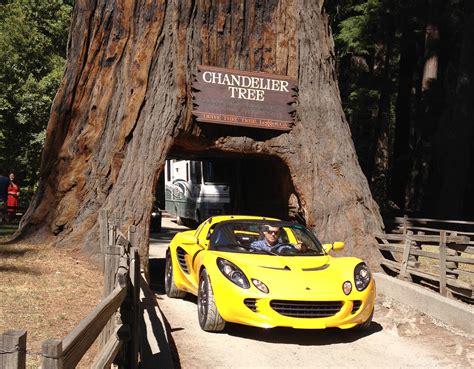
A doctor does not guess at health. Why would an arborist? How many times does an individual go in for a routine check-up with a doctor and find out there may be something wrong, sometimes seriously ASK THE TREE™
wrong. A doctor does a routine health exam, finds something amiss, does further testing and continues until the problem is identified.
And, just like people, plants can be unhealthy, with no visible signs of distress, until they are almost beyond saving. When property owners hire an arborist to take care of their trees, they expect he/she will keep their plants healthy, not let them get sick and then try to revive them.
But since organisms try to cover up their problems, how does the plant care professional know if a tree (or any other plant) is truly healthy? The same way the medical doctor does - test.
Diagnostics
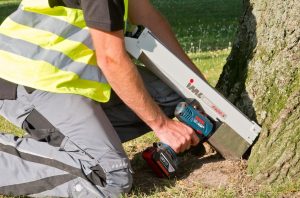
Most arborists are too busy doing sales calls, service calls or otherwise operating a plant healthcare business to get directly involved with diagnostic testing. However, if growing your company and providing the best care to your client’s trees is appealing to you, there is a broad range of tests and test equipment you could utilize. By investing a few hundred dollars, you could test for pH, stress and buy a Soil Profiler for available nutrient testing. For several hundred more, you could add, chlorophyll, carbohydrate, or conductivity (energy) testing. For thousands more you can add structural testing.
Contact us if you would like further information.
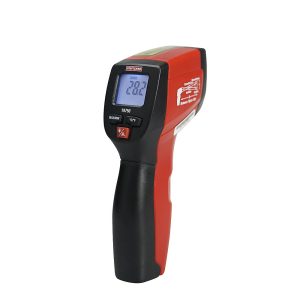
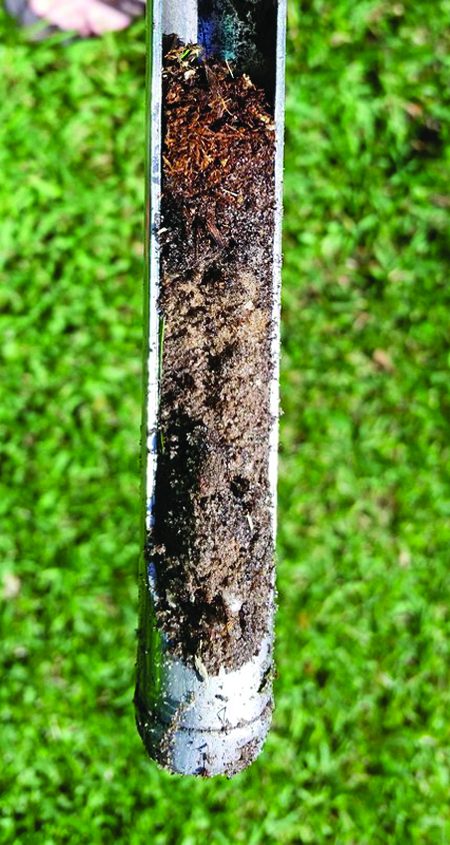
Horticultural (nutrient availability) soil testing and the biological soil testing are best left to the professional labs that have the specialized equipment (costing about 1 million dollars) to get you the professional results you need. The two items you should have is a soil profiler/sampler to collect soil for testing and check for compaction; and an infrared thermometer to check the temperature of leaves. In the same way that our body temperature is one of the earliest signs of a health problem, if a plant’s leaf is more than 10 °F different than the air temperature, then the plant is under stress for some reason.
Benefits of Using Third Party Analysis:
The arborist will reap a number of benefits from using third party services:
- Your client will know that you are not making up problems just to create income for your
company. - They are familiar with the concept - it is identical to their family doctor’s use of an
independent lab. - They are more likely to invest in the suggested course of action.
- It increases your stature as a professional since professionals frequently use outside specialists.
What Should I Charge for Diagnostic Work?
Companies differ in how they view the cost and income potential of diagnostic work.
- Some have a standard fee, or an hourly fee that includes tools.
- Others charge differently depending on the type of diagnostic work being done, analysis with a Resistograph being more expensive than a thermometer or soil profiler.
- Some want consulting/diagnostic work to be a profit center.
- Others feel that it brings in enough business, closes the sale or sets them apart from their
competitors to be a loss leader, worth the expense either partially or in full.
Unless you operate purely as a consultant, the cost of your fees should not scare customers away from buying your services, which represents the bulk of most company’s income. The ASK THE TREE program can create multiple sources of income for an arborist, but care must be given to develop a program that creates the value customers are seeking within a cost range with which they are comfortable. Just as the consumer wants to keep their costs constant, as a business person, you want to create continuous, consistent cash flows for your company. In the final analysis, the greatest income is generated in the long term business created and the referrals provided, not the diagnostic fees alone.
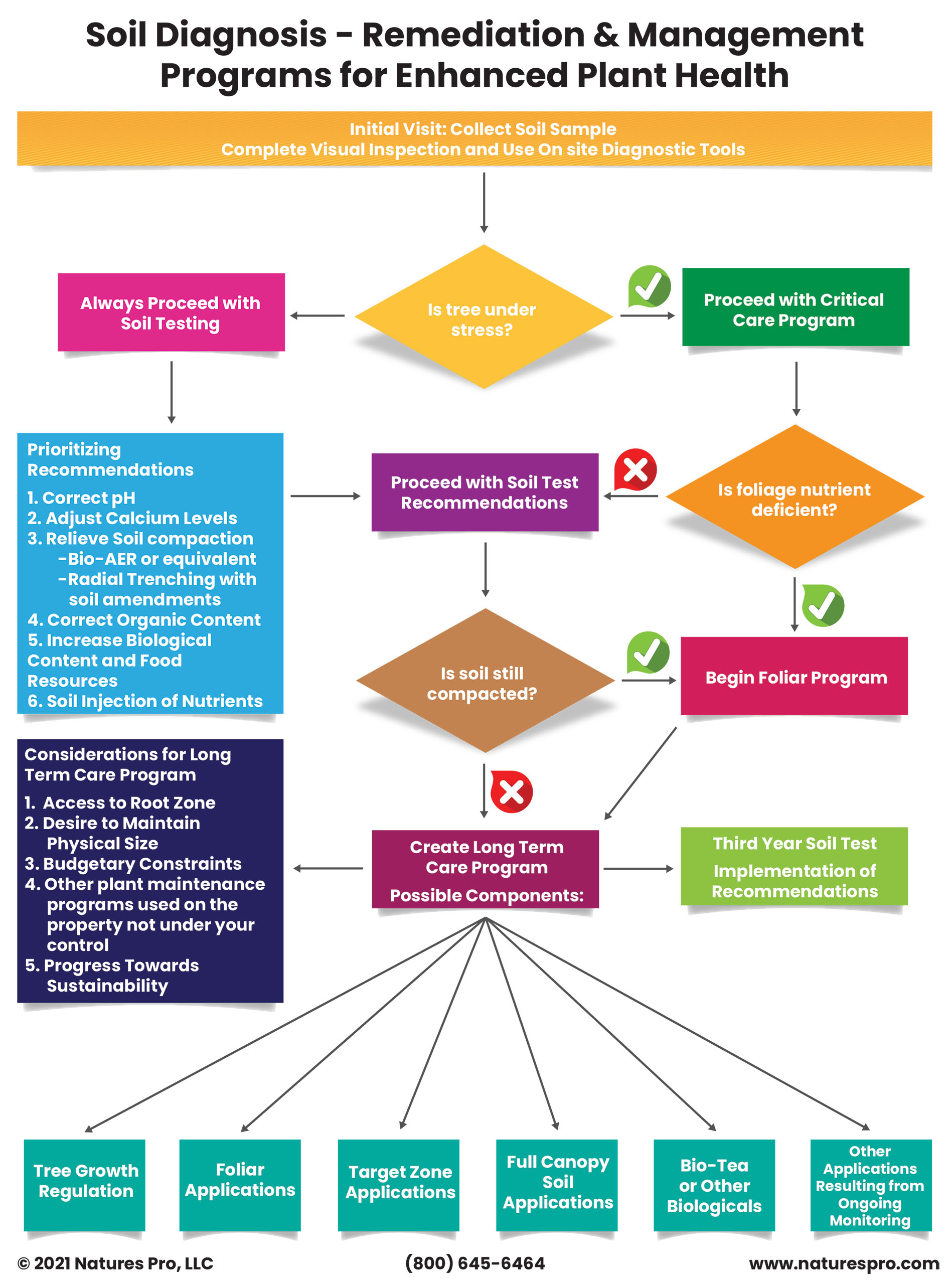
pH Sets the Stage
The building blocks of plant health are both essential and sequential, each building on the other:
- Adjusting the soil pH to match what the tree prefers also makes the nutrients the tree requires more available.
- Fix calcium levels for a host of reasons.
- Loosen compact soil to provide more air.
- Add organic matter to support biology and retain moisture.
- Add biology to release nutrients and maintain pH.
- THEN do the correct nutrient program OR do a Foliar Program to bypass the soil prior to it being “fixed.”
16 elements are essential - sunlight, water, air and 13
nutrients. However, nutrients can’t work without the proper
pH. What sense does it make to begin a nutrient program without knowing whether the nutrients can even be utilized?
Besides the economic loss, will those unused nutrients end up leeching into the water supply?
Roots cannot live without air or water, so opening up the soil
(think calcium) may be more critical than adding nutrients.
However, if your soil test does not provide soil typing along with pH, you will not know exactly how much and which products are needed to affect change.
Money-Making Examples
A Horticultural Soil Analysis is a comprehensive tool that can maximize the results of soil amendments and fertilizing. For a small investment, you and your customers may be rewarded with more beautiful trees and shrubs that are healthier, thus requiring less chemical interventions.
All application prices below are per 100 square feet:
pH - Begin addressing health issues by determining and adjusting pH. Every plant has a specific pH range in which it will be its healthiest. This range varies within species and even varieties. Price estimates are based on 3x product cost per 100 sq. ft. of canopy.
Loamy Sand Soils (Lime) $1.25 - $4.05*
Clay Loam Soils (Lime) $1.00 - $6.10*
Calcium - The second most important soil correction, even before applying typical nutrients, is calcium adjustment. The benefits of calcium are numerous, including making nitrogen more plant available and reducing soil compaction. To adjust calcium without adjusting pH, the product should have little or no magnesium. The following prices are for pelletized Calcium Sulfate (gypsum).
Loamy Sand Soils (Gypsum) $3.15 - $7.95*
Clay Loam Soils (Gypsum) $9.45 - $14.25*
Notice the dramatic difference soil type makes!
Other soil tests do not provide this information.
Organic Matter - Are you adding organic matter now if needed? Get the soil to work for the plant.
Organic Recommendation $2.25 - $9.00*
Soil Biology - How about adding live microbes to facilitate nutrient availability and disease resistance?
Bio-Tea $10.00 - $20.00*
*Price range is based upon the soil test starting point. Higher costs reflect poorer nutrient test results.(i.e. low, very low, or extremely low)
SUMMARY OF ADDITIONAL
MONEY MAKING POTENTIAL
Example: Clay Loam
(which requires more amendment)
Tree Canopy - 30’ radius or
2800 sq. ft.
Lime: $170
Gypsum: $399
Organics: $252
Microbes: $280
Additional Income: $1101
(about 40¢ per sq. ft.)
This additional income would be spread over at least two years. It is not limited by weather or the
calendar, it can be used to fill-in, extend or jumpstart the season and could be done in combination with other income-producing services, like lower cost Foliar Feeding or Target Application Zone Root Feeding.
THe Bottom Line
Some form of diagnostics, particularly early in the plant management process, can reap huge benefits, whether it is for trees, turf, gardens, crops, or any kind of plant material.
Consumers who are provided solid, commonsense information about tree diagnostic and maintenance programs are often willing to make the investment. In some cases, the results of the diagnostics will save them money. In others, they will invest more money in order to save irreplaceable plant material.
Offering a broader spectrum of health services than just fertilizing and treating with pesticides generates new income streams.
We can provide you a multi-year, multi-treatment Soil Care Program that creates better plant health and not have your customer ask, “How many years in a row do I need fertilizer?” If customer retention is important to you, Asking the Tree should be a top priority. Ask us for details.
Asking the Tree will do the right
thing for the tree, the right thing
for your customers, and it will
create more business
for you!